
Aktualności | News
Ben Cartlidge breaks down Reljic vs Vegh scoring
The experienced judge of over hundread bout in UFC, KSW and Cage Warriors organizations Ben Cartlidge breaks down the scoring of the Goran Reljic vs Attila Vegh championship contest.
The very nature of a split decision inevitably means that one fighter, one party or one set of supporters are going to be unhappy with the verdict. The common misconception with a split decision is that two of the judges completely disagreed with the dissenter in every way imaginable, but most splits revolve around a one close round which separates opinion.
In this fight between Goran Reljic and Attila Vegh however, both fighters were so well matched in terms of initially obvious output that it was entirely possible to arrive at many different final totals. The fact that only one round divided the final scorecards is a testament to the performance of the judges assigned to this bout.

Looking at all the rounds in order, the first stanza is perhaps the closest to being described as clear, quite a statement when we just how close this fight was. Goran Reljic’s sound defensive work is truly put to the test by Vegh who attacks with powerful short bursts and from unorthodox angles. This pattern is repeated for the majority of the round despite Goran’s attempts to mix his attacks up. Attila swings aggressively at times but still makes it count when he needs to, landing more volume and the bigger shots throughout the opening five minutes.

The second round is interesting in its similarity to the first, but Reljic is able to effectively adjust his output by coupling with his sound defensive work with tight counters. Vegh looks to repeat what has worked for him in the previous five minutes but Reljic has his timing much sharper; this allows the shots that Vegh was landing in the first to be parried and countered a lot more in the second. There is a brief exchange by the cage for about 20 seconds but nothing overly significant happens there before Vegh breaks away. Another difference in this round is that Reljic also spends marginally more time in the centre of the cage pushing the action. It’s a very tight round, and a big flurry or a takedown could have easily swung the round either way.
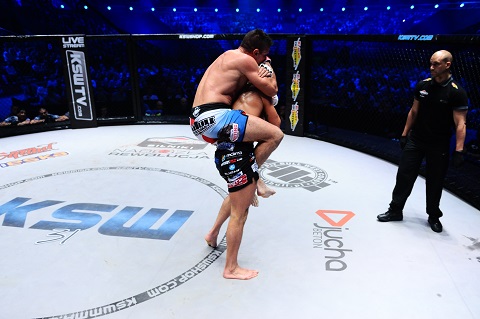
The third round also is a similar to the previous two but there is a sequence that starts with a Reljic takedown after just 45 seconds of the first round. Goran quickly secures the back and is locked in for around 40 seconds. He lands a few short hammerfists before jumping on the choke that he nearly finishes, but that allows Vegh to spectacularly reverse. In the ensuing scramble Vegh lands a pair of nice shots but loses his balance and allows Reljic time to recompose himself. The rest of the round plays out in a similar fashion to the majority of the fight, with Reljic showing great defensive savvy and countering while Vegh attacks in bursts.
All three judges agreed that Attila Vegh won the first round and that Goran Reljic won the final round, with the second separating the scores and generating the split decision. A re-watch of the fight certainly reinforces just how close it was and also explains why certain parties disagreed with the verdict.
It’s easy to label a scorecard that you don’t agree with as a “robbery”, but upon close inspection, there is usually always the smallest set of circumstances or events that separate what persuades one judge to score a round differently than that of his fellow officials.
The very nature of a split decision inevitably means that one fighter, one party or one set of supporters are going to be unhappy with the verdict. The common misconception with a split decision is that two of the judges completely disagreed with the dissenter in every way imaginable, but most splits revolve around a one close round which separates opinion.
In this fight between Goran Reljic and Attila Vegh however, both fighters were so well matched in terms of initially obvious output that it was entirely possible to arrive at many different final totals. The fact that only one round divided the final scorecards is a testament to the performance of the judges assigned to this bout.
Looking at all the rounds in order, the first stanza is perhaps the closest to being described as clear, quite a statement when we just how close this fight was. Goran Reljic’s sound defensive work is truly put to the test by Vegh who attacks with powerful short bursts and from unorthodox angles. This pattern is repeated for the majority of the round despite Goran’s attempts to mix his attacks up. Attila swings aggressively at times but still makes it count when he needs to, landing more volume and the bigger shots throughout the opening five minutes.
The second round is interesting in its similarity to the first, but Reljic is able to effectively adjust his output by coupling with his sound defensive work with tight counters. Vegh looks to repeat what has worked for him in the previous five minutes but Reljic has his timing much sharper; this allows the shots that Vegh was landing in the first to be parried and countered a lot more in the second. There is a brief exchange by the cage for about 20 seconds but nothing overly significant happens there before Vegh breaks away. Another difference in this round is that Reljic also spends marginally more time in the centre of the cage pushing the action. It’s a very tight round, and a big flurry or a takedown could have easily swung the round either way.
The third round also is a similar to the previous two but there is a sequence that starts with a Reljic takedown after just 45 seconds of the first round. Goran quickly secures the back and is locked in for around 40 seconds. He lands a few short hammerfists before jumping on the choke that he nearly finishes, but that allows Vegh to spectacularly reverse. In the ensuing scramble Vegh lands a pair of nice shots but loses his balance and allows Reljic time to recompose himself. The rest of the round plays out in a similar fashion to the majority of the fight, with Reljic showing great defensive savvy and countering while Vegh attacks in bursts.
All three judges agreed that Attila Vegh won the first round and that Goran Reljic won the final round, with the second separating the scores and generating the split decision. A re-watch of the fight certainly reinforces just how close it was and also explains why certain parties disagreed with the verdict.
It’s easy to label a scorecard that you don’t agree with as a “robbery”, but upon close inspection, there is usually always the smallest set of circumstances or events that separate what persuades one judge to score a round differently than that of his fellow officials.
Inne wpisy

XTB KSW 121 – where to watch
XTB KSW 121 is taking place on Saturday, September 19th in Liberec. The main event will be the interim heavyweight title match between Štefan Vojčák r...

Q&A With Laura Grzyb
Poland’s undefeated IBO boxing world champion and KSW MMA star Laura Grzyb (3-0 MMA, 12-0 boxing) steps back into the KSW cage this Saturday,...